Maid Insurance Singapore 2026: From $280 for 26 Months, MOM's $60,000 Rule and What's Covered
Updated: Aug 21
Let me start with the question I get at every first consultation: "Do I really need to buy insurance for my helper, or is that just the agency trying to add on?" It's a fair thing to ask, because on the day you sign, the insurance line item looks like just another fee in a long list of fees. But this one is different — it's the one MOM actually requires, the one that protects your bank account as much as it protects her, and the one families most often discover they've misunderstood only when a hospital bill lands on the table.
So here's the whole picture in plain numbers: what you're legally required to buy, what it costs in 2026, and — the part nobody explains at the signing — exactly who pays what when she actually gets sick.

At a glance: the maid insurance rules
$60,000 is the minimum annual medical insurance (MI) coverage for every helper — it must cover inpatient care and day surgery.
$60,000 is also the minimum personal accident insurance (PAI) sum assured — a lump sum for permanent disability or death from an accident.
On claims above $15,000, insurers pay 75% and you pay 25% — that co-payment kicked in on 1 July 2023.
A typical 26-month policy costs $280 to $800 — under-50 helpers start from about $280.
Insurance must be bought before she arrives, and you are not allowed to deduct the cost from her salary.
Since 1 July 2025, premiums are age-banded (50 and below vs above 50) and insurers pay hospitals directly.
What MOM actually requires
Let's be precise about the legal minimum, because agencies sell you a lot of things that are nice to have, and only two of them are compulsory. The first is medical insurance. MOM requires every helper to be covered by an MI policy with an annual claim limit of at least $60,000 per year, and that coverage has to include inpatient care and day surgery. And here's a detail most people miss: if the policy has sub-limits — say, a separate cap for inpatient care, or a "per condition" cap — every single sub-limit has to meet that $60,000 floor on its own. A policy that caps day surgery at $20,000 does not comply, even if the headline number says $60,000.
The second compulsory policy is personal accident insurance. This one isn't about hospital bills at all — it's a lump sum of at least $60,000 per year, payable to your helper or her beneficiaries if she suffers permanent disability or dies as a result of a sudden, unforeseen accident. The policy can't carry extra exclusion clauses beyond what the regulations allow, which is a polite way of saying "don't buy the cheap policy with seventeen carve-outs."
Requirement | What it must cover | Minimum |
Medical insurance (MI) | Inpatient care and day surgery | $60,000 annual claim limit |
MI sub-limits | Each sub-limit (e.g. per condition) | $60,000 each |
Personal accident (PAI) | Permanent disability or death from accident | $60,000 sum assured |
Co-payment (since Jul 2023) | Claims above $15,000 | Insurer 75% / employer 25% |
Premium payment | Cost of both policies | Employer pays — cannot deduct from salary |
One more rule that surprises people: you can't pass the premium on to her. MOM is explicit that the cost of insurance is the employer's, and deducting it from her salary is an offence. When you see those "insurance recovery" lines on some agencies' invoices, that's a red flag worth asking about.
The co-payment: where the real money is
Here's the change that most families still haven't absorbed. Before July 2023, the minimum was a much smaller sum, and the insurer picked up the whole bill up to the limit. Now, with the enhanced medical insurance, the structure is: the insurer covers the first $15,000 of claims in full, and anything above that gets split — 75% paid by the insurer, 25% by you. MOM introduced this to keep premiums affordable while pushing the limit up to $60,000, and the honest way to describe it is that you now carry a share of the big bills rather than the whole premium jump.
Let me show you what that actually means in dollars, because this is where most people's eyes glaze over until they see a real number:
Hospital bill | Insurer pays | You pay |
$10,000 | $10,000 | $0 |
$15,000 | $15,000 | $0 |
$30,000 | $26,250 | $3,750 |
$60,000 | $48,750 | $11,250 |
A $30,000 bill — a serious surgery with a few nights in a private hospital, say — leaves you with $3,750. A $60,000 bill, which is the outer edge of what the policy covers, leaves you with $11,250. That's not pocket change, and it's why I tell every family the same thing: the insurance isn't a magic shield, it's a risk-sharing arrangement, and the part you're responsible for starts exactly where the serious medicine begins. The one saving grace is that Stage 2 of the enhanced rules, which took effect on 1 July 2025, made insurers pay hospitals directly once a claim is admitted — so at least you're not fronting the cash and waiting for reimbursement on the big items.
What maid insurance costs in 2026
Now the number everyone actually wants. For a typical 26-month policy — which is how helper insurance is sold in Singapore, roughly matching the standard work permit cycle — you should expect to pay somewhere between $280 and $800 all in. The spread depends on the insurer, the plan tier, and since the July 2025 rule change, your helper's age: insurers now price two bands, 50 and below versus above 50, and the older band typically runs 15% to 25% more.
Type of plan | Typical premium (26 months) | Notes |
Basic MOM-compliant | ~$280 – $350 | Meets the $60,000 MI + $60,000 PAI minimums |
NTUC Income Enhanced | $278 – $488 | Under-50 helpers; the most commonly quoted plan |
Etiqa / Tiq budget tier | ~$282 | Budget option, before promotions |
Comprehensive plans | $400 – $800 | Higher limits, outpatient or dental riders |
Helper above 50 | +15% – 25% | Stage 2 age-banded pricing |
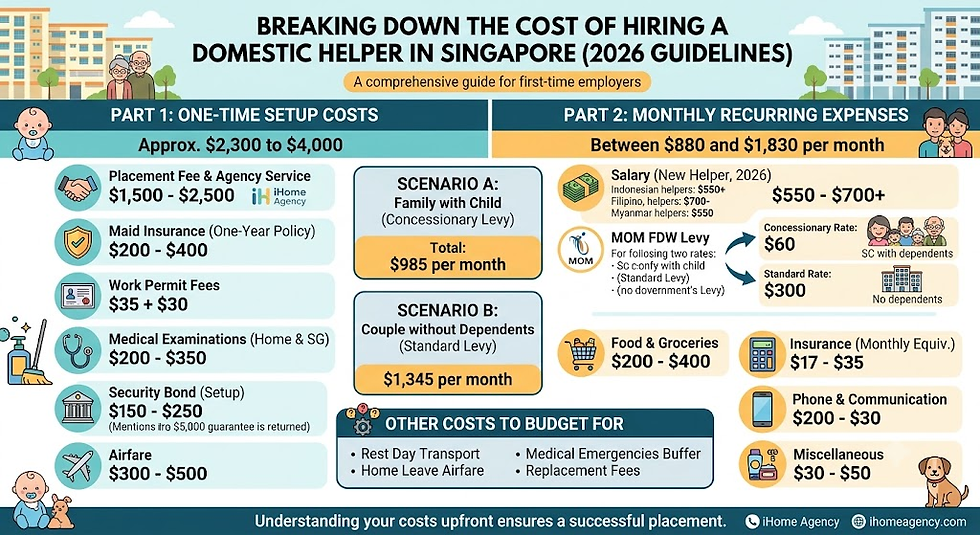
To put that in monthly terms: a $300 premium over 26 months works out to about $11.50 a month — less than two hawker meals, for coverage that caps your exposure on a six-figure surgery at a quarter of the excess. It is, by a wide margin, the cheapest insurance you will ever buy. And yes, that $300 sits inside the bigger monthly number we've broken down in our full 2026 cost breakdown, so if you're budgeting the whole arrangement, it's already in there.
What's covered — and what still comes out of your pocket
Here's the part that saves families from a nasty surprise, so read it twice. The mandatory MI covers hospitalisation and day surgery — the expensive stuff. It does not automatically cover the everyday things, and the everyday things are where employers quietly spend hundreds a year without realising it.
Item | Covered by mandatory MI? | What usually happens |
Hospitalisation (inpatient) | Yes | Up to the $60,000 annual limit |
Day surgery | Yes | Up to the $60,000 annual limit |
GP clinic visits (outpatient) | Usually no | Employer typically pays out of pocket |
Dental treatment | Usually no | Employer typically pays out of pocket |
Accident → permanent disability or death | Via PAI | Separate $60,000 lump sum |
The practical takeaway: a trip to the polyclinic for a fever, or a filling at the dentist, is almost always your bill. Some comprehensive plans bundle outpatient or dental riders, and if you have a helper who's prone to the sniffles or a family that wants dental covered, the rider is usually worth more than the upgrade cost. We've written the full playbook on what happens when your helper gets sick — insurance included — if you want the medical side in detail.
Buying it the right way
Three practical notes, and then you're done. First, the insurance has to be in place before your helper arrives in Singapore — MOM checks it as part of the work permit process, and your agency will usually arrange it for you as part of the package. If they do, ask to see the policy schedule and check the two numbers that matter: the $60,000 MI limit and the $60,000 PAI sum assured. Second, keep a copy of the policy with her documents — when she's admitted to hospital, the insurer needs to be notified fast, and the last thing you want is a claims dispute because the paperwork took a week to surface. Third, and this is the one I repeat most: the insurance is a floor, not a ceiling. The full list of what you're responsible for as an employer — insurance included — lives in our complete MOM responsibilities guide, and it's worth a re-read every time you renew.
The bottom line
Here's how I'd sum it up for a friend. Maid insurance in Singapore costs you roughly $280 to $800 for a 26-month policy — call it $11 to $30 a month — and in exchange it caps your exposure to a $60,000 medical claim at a quarter of the excess, with a $60,000 accident payout on top. It is compulsory, it must be in place before she arrives, and you cannot make her pay for it. The only real decisions are which plan and whether to add riders — and both are easy ones once you know the minimums. Like most things with a helper, the peace of mind costs a fraction of what the absence of it does.
Frequently Asked Questions
How much does maid insurance cost in Singapore?
A typical 26-month policy costs $280 to $800, depending on the insurer, plan tier, and your helper's age. Under-50 helpers commonly pay $280 to $488 (NTUC Income's Enhanced plan runs $278 to $488), and helpers above 50 cost roughly 15% to 25% more under the age-banded pricing introduced in July 2025.
Is maid insurance compulsory for foreign domestic workers?
Yes. MOM requires every helper to have medical insurance with at least $60,000 annual coverage for inpatient care and day surgery, plus personal accident insurance with at least $60,000 sum assured. Both must be bought before she arrives, and the employer must pay — deducting the cost from her salary is not allowed.
What is the minimum medical insurance coverage for a maid in Singapore?
At least $60,000 per year in annual claim limit, covering inpatient care and day surgery. If the policy has sub-limits — such as per-condition or per-treatment caps — each sub-limit must also meet the $60,000 minimum.
Who pays the 25% co-payment on a maid's hospital bill?
The employer pays it. Under the enhanced medical insurance rules since 1 July 2023, the insurer covers the first $15,000 of claims in full, and 75% of anything above that — the remaining 25% is yours. On a $30,000 bill, that's $3,750 out of your pocket.
Does maid insurance cover outpatient clinic visits and dental?
Generally no. The mandatory medical insurance covers hospitalisation and day surgery; GP visits and dental treatment are usually paid by the employer out of pocket. Comprehensive plans with outpatient or dental riders are available for a higher premium if you want that coverage.
Can I deduct maid insurance costs from my helper's salary?
No. MOM is explicit that the cost of medical and personal accident insurance is the employer's responsibility, and deducting it from the helper's salary is an offence.
Ready to find the help your home deserves? Check out our guide on which nationality suits you best.
Let us guide you home.
Contact iHome Agency:
📲 WhatsApp: 8042 6581
📜 EA License: 26C3446
📍 Punggol & Northshore Specialist