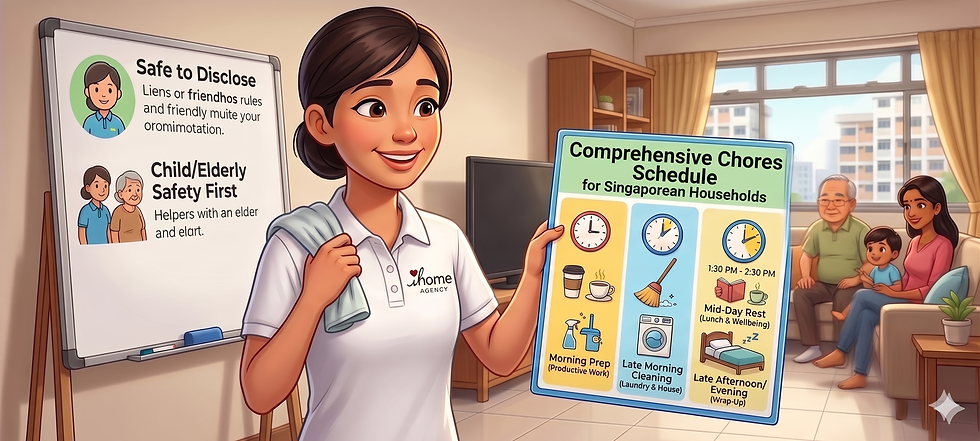
The 30-Day Domestic Helper Onboarding Guide: iHome Singapore Integration Program
Updated: Aug 17
It typically takes 30 to 90 days for a foreign domestic helper to fully adapt to a new household's rhythm, communication style and standards. iHome Singapore's 30-Day Domestic Helper Onboarding Guide is a step-by-step roadmap built on a high-frequency, 6-point agency check-in framework designed to accelerate that timeline and prevent early resignations or transfers.
At a Glance: iHome's 30-Day Integration Program
A helper typically needs 30–90 days to fully adapt to a new household.
iHome's 30-Day program uses a high-frequency 6-point agency check-in framework — not just start-and-end touchpoints.
Weekly agency touchpoints intercept language, cultural and expectation issues before they escalate.
Three core benefits: linguistic mediation, cultural realignment and expectation management.
Proactive check-ins prevent costly helper transfers and early resignations.
Traditional Agency vs iHome's 6-Point Check-in
Aspect | Traditional agency | iHome 30-Day program |
Check-ins | Start & end (or only on crisis) | High-frequency weekly |
Language gaps | Surface as frustration | Mediated early |
Culture | Self-serve adjustment | Guided realignment |
Expectations | Set once | Managed weekly |
Why High-Frequency Check-ins Save Placements
Traditional agencies often drop out of communication once a helper is deployed, stepping in only when a crisis occurs. But human relationships need consistent, proactive care during the adjustment phase. iHome's 6-point check-in system acts as an early-intervention mechanism with three core benefits: Linguistic Mediation — resolving subtle translation or instruction gaps before they trigger frustration or mistakes; Cultural Realignment — helping helpers adapt to the fast pace and space constraints of Singapore apartments; and Expectation Management — helping employers pace their instructions so helpers are trained systematically rather than overwhelmed.
The Payoff
Investing in an organised 30-day integration strategy backed by an agency partner that checks in every week saves months of future friction, prevents costly helper transfers, and keeps the household peaceful and orderly. A successful placement is not just matching resumes — it is building mutual trust and structured routines from day one.
Frequently Asked Questions
How long does it take a domestic helper to adapt to a new household?
It typically takes 30 to 90 days for a foreign domestic helper to fully adapt to a new household's rhythm, communication style, dietary preferences and operational standards. A structured 30-day onboarding program significantly accelerates this timeline.
What is a domestic helper onboarding program?
It is a structured roadmap that guides a new helper through her first weeks — covering cultural adjustment, language gaps, household routines and expectation-setting — so she integrates smoothly instead of struggling and requesting a transfer.
What is iHome's 6-point check-in framework?
It is iHome's high-frequency agency check-in system during the helper's first 30 days: weekly touchpoints that provide linguistic mediation, cultural realignment and expectation management to intercept issues early.
Why do new helpers transfer or resign early?
Most early transfers stem from unmanaged cultural adjustment, unresolved language gaps and overwhelming expectations — all of which build up silently in the first month when agencies check in only at the start and end.
How does high-frequency check-in prevent helper transfers?
Weekly agency touchpoints catch minor miscommunications and cultural friction early, letting the agency mediate before frustration turns into a resignation or transfer request — saving months of disruption and cost.
Contact iHome Agency — WhatsApp 8042 6581 · EA Licence 26C3446 · Punggol & Northshore specialist.