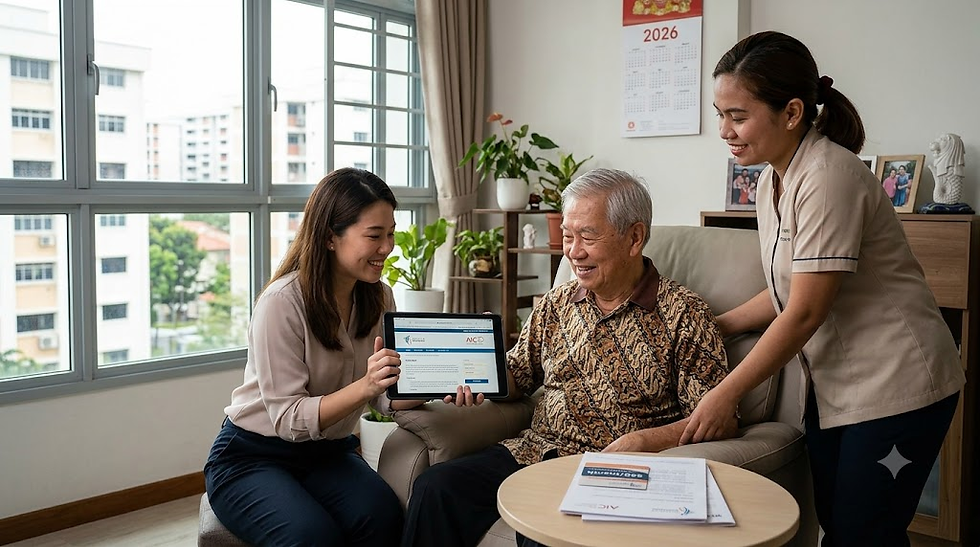
Maid for a Special Needs Child Singapore 2026: Costs
Somewhere in Singapore tonight, a parent is reading the same therapy report for the fourth time. The recommendations are not complicated. Twenty minutes of practice before school. A predictable routine after it. Someone patient enough to repeat the same instruction until it sticks. What the report does not say is who will actually carry it out, because most households cannot spare one adult for the whole day.
That is usually the moment a family starts thinking about a domestic helper. It is a sensible thought. A helper can be the steady second pair of hands that turns a therapy plan into something that happens every day rather than only on weekends. But a helper hired to keep a flat clean and a helper hired to carry a child's development programme are not the same hire. Families who treat them as one often end up with a very tidy home and a child who has not moved forward.

At a Glance
Levy: $300 a month for a first helper, or the concessionary $60 if an eligible person lives with you, and a child with a certified disability can make you eligible. Salary: 2026 market rates run from $450 to $850 a month depending on nationality and experience, and this is one hire where paying near the top of your range is worth the money. Training: AIC's Caregivers Training Grant provides $400 in the first year and a $200 top-up every financial year, capped at $400, and your helper can attend as the caregiver. Insurance: medical cover of at least $60,000 a year and personal accident cover of at least $60,000 are legal requirements, not optional extras. Time: give the arrangement six to eight weeks before you judge it, because the first month is learning, not performance.
Why This Hire Is Different
Most helper placements are built around chores. Meals on the table, laundry moving through the week, floors that stay clean. When a child in the home has developmental needs, the centre of gravity shifts without the chore list disappearing. The helper may become the person who sits on the floor for the home programme a therapist designed, who keeps the visual schedule on the wall, who notices that a specific noise before dinner always ends in a meltdown, and who can describe that clearly enough for you to raise it at the next appointment.
That is caregiving work, and it is a skill rather than a personality trait. Our guide to caregiver training in Singapore covers the courses that build it, and it is worth reading before you interview anyone, because knowing what good training looks like changes the questions you ask.
What the Job Actually Involves
It helps to be concrete before you write a job description, because vagueness is where placements go wrong. In a household with a child who has additional needs, the week usually includes some version of the following.
Carrying out the home programme. The exercises, the practice, the repetition, done the way the therapist asked rather than the way that feels easiest.
Keeping the routine stable. The same order, the same cues, the same words, because predictability is what lowers anxiety for many children.
Being the eyes at appointments. Notes on sleep, appetite, behaviour and what worked, so nothing important is lost between sessions.
Handling transitions and public spaces. Escalators, crowds, noise, a plan that changes at the last minute.
Safety awareness that is specific to your child. Wandering, bolting, swallowing, seizures, sensory overload in a shopping centre.
Working alongside you rather than instead of you. A helper amplifies a parent. She cannot replace therapy, and no good helper will claim otherwise.
The Cost in 2026: Salary, Levy and Insurance
Start with the salary, because everything else is built on it. Market rates for 2026 put Filipino helpers at $600 to $850 a month, Indonesian helpers at $500 to $700, Myanmar helpers at $450 to $600, and Indian or Sri Lankan helpers at $500 to $650, with experience and specialist skills pushing a helper towards the top of her range. For a child with additional needs, budget near the top rather than the bottom. The difference of $100 a month is small against the cost of a placement that collapses in month three.
Nationality | Typical monthly salary | Levy | Insurance | All-in monthly estimate |
Filipino | $600 to $850 | $300, or $60 with concession | $100 to $200 | $900 to $1,550 |
Indonesian | $500 to $700 | $300, or $60 with concession | $100 to $200 | $800 to $1,400 |
Myanmar | $450 to $600 | $300, or $60 with concession | $100 to $200 | $750 to $1,300 |
Indian or Sri Lankan | $500 to $650 | $300, or $60 with concession | $100 to $200 | $800 to $1,350 |
The all-in column includes food, which most families budget at $150 to $200 a month. It does not include therapy fees, transport to appointments, or the one-off agency costs of a placement.
The levy is where families with a child with additional needs often leave money on the table. The concessionary rate of $60 a month applies on the young child scheme when a Singapore citizen child below 16 lives at your address, and that holds whether or not the child has a disability. If your child is 16 or older, or a permanent resident, the route is the persons with disabilities scheme. That one needs a Singapore registered doctor to certify that the child requires help with at least one activity of daily living, the same NRIC address on both records, the child listed as a household member on FDW eService, and a recommendation letter from AIC. Our walkthrough of the levy concession application covers the paperwork step by step.
The Same Job, Two Very Different Hires
It is easy to assume that a capable helper can add a child's programme to her existing duties. Sometimes she can, with training and a clear brief. Often she cannot, because the work rewards different instincts. That difference is what matters when you write the job description and when you interview.
Area | Helper hired for housework | Helper hired for a child with additional needs |
Main deliverable | A clean, organised, well-run home | A stable routine and consistent practice on top of the housework |
Instruction style | Follows a task list in her own order | Follows a written plan, adapts when the child resists, reports back |
Contact with professionals | Rare | Regular, with therapists, teachers and you |
What you must provide | A schedule | Training, supervision, written expectations and backup |
Cost of a wrong fit | Chores slip for a few weeks | The programme stalls and the child loses months |
What Support You Are Entitled To
Few families know how much of this is subsidised, and the support is specific rather than general. These are the four schemes worth knowing before you sign anything.
Support | What it provides | Key conditions | Where to apply |
MDW levy concession | $60 a month instead of $300 | Eligible person living in the household, same NRIC address, listed on FDW eService. The disability route also needs doctor certification and an AIC recommendation | MOM FDW eService, with AIC for the disability route |
Caregivers Training Grant | $400 in the first year, then a $200 top-up each financial year, capped at $400 | Care recipient is a citizen or PR aged 65 and above, or has a disability. The caregiver can be your helper | AIC, using approved courses in the Caregivers Training Catalogue |
Medical insurance | At least $60,000 a year for inpatient care and day surgery | Must be in place for the whole employment period | Your insurer, usually arranged with the agency |
Personal accident cover and security bond | At least $60,000 personal accident cover, plus a $5,000 security bond | Required by MOM before the work permit is issued | Your insurer, usually arranged with the agency |
One practical note on the training grant. The money sits with the care recipient rather than the helper, and each approved course carries a co-payment of at least $10. In practice that makes the first courses almost free, which is why the grant is the cheapest quality upgrade available to you in the first month of a placement.
How to Interview for It
A CV will tell you where a helper has worked, not what she did there. The way to find out is to ask her to describe a normal day in detail, then listen for the specifics. Anyone who has genuinely cared for a child with additional needs will talk about routines, small wins, and the things that used to go wrong.
Question | Weak answer | Strong answer |
Tell me about the last child you looked after. | I love children and I am very patient. | The age, the difficulties, the daily routine, who else was involved |
What did the therapist ask you to do at home? | I am not sure, the mother did that part. | Names the tasks and explains why they mattered |
What do you do when the child refuses the exercise? | I tell the mother and stop. | Tries the agreed options first, stays calm, records it, reports at the end of the day |
How would you handle a meltdown in a shopping centre? | I carry him out quickly. | Reduces noise and attention, uses the child's calming routine, keeps him safe, does not punish |
Are you willing to attend training? | I already know how to take care of children. | Asks what the course covers and mentions something learned from earlier training |
Green flags are quieter than red ones. A helper who keeps notes, who asks what your child finds difficult before asking about her day off, and who is comfortable being corrected by a therapist is worth more than one with confident answers.
Experience that can be described in routines and examples rather than in adjectives.
Willingness to be trained and to follow a plan she did not design.
Calm, simple language when talking about children, including difficult behaviour.
A clear understanding that the parent leads and she supports.
Realistic expectations about rest days, phone use and privacy, discussed before day one.
Common Mistakes to Avoid
Hiring out of sympathy rather than skill. A hard-luck story is not evidence of competence, and the child pays for the mismatch.
Leaving the therapy expectations verbal. If it is not written down, it becomes negotiable in week three.
Skipping training because she is already experienced. The experience may be with a different child, a different condition and a different family's way of doing things.
Expecting the helper to be the therapist. She carries out a programme. Assessment and clinical decisions belong to the professionals.
Forgetting the siblings. A household organised entirely around one child's needs creates a second, quieter problem that surfaces years later.
When It Still Does Not Work
There are recognisable signs that a placement is not going to settle. The helper avoids the practice sessions and finds housework to do instead. Notes stop being written. She starts describing your child in fixed, hopeless terms rather than practical ones. You find yourself re-explaining the same instruction every week, and the therapist notices that nothing is being carried through.
Before you decide anything, try the cheap fixes. Written expectations, a short refresher course funded through the training grant, a weekly fifteen-minute review, and one honest conversation about what she finds hard. If none of that shifts the pattern, a transfer is a legitimate outcome rather than a failure. Our comparison of transferring a helper versus hiring a new one sets out the real costs, and the guide on choosing the right helper is worth rereading before the second attempt, because the same brief produces the same result.
Frequently Asked Questions
Can a domestic helper care for a child with special needs in Singapore?
Yes. A helper employed by your household can care for your child at home, follow a home programme, and accompany your child to school and therapy appointments. The condition is that she is employed by you and works in your household, since the work permit is tied to your address.
How much does a helper for a child with special needs cost in 2026?
Budget $750 to $1,550 a month all in. That covers salary of $450 to $850 depending on nationality and experience, levy of $300 or the concessionary $60, insurance of $100 to $200, and food of $150 to $200. Expect to pay towards the top of the range for a helper with relevant experience.
Do I still pay the $300 levy if my child has a disability?
Usually not. A Singapore citizen child below 16 in your household qualifies you for the $60 concessionary rate on the young child scheme. For an older child or a permanent resident, the persons with disabilities scheme applies, which requires doctor certification of at least one activity of daily living limitation, matching NRIC addresses on both records, the child listed on FDW eService, and an AIC recommendation letter.
Can my helper attend caregiver training, and who pays?
In most cases AIC pays for most of it. The Caregivers Training Grant gives $400 in the first year and a $200 top-up each financial year up to a $400 cap, and your helper is explicitly allowed to attend as the caregiver. Each approved course carries a co-payment of at least $10, so the training is close to free in practice.
Can my helper accompany my child to therapy and school?
Yes, and it is one of the most useful things a helper can do. Put the expectation in writing so that reports reach you the same day, agree who pays for transport, and keep the handover short by asking her to note what the therapist said, what the child did, and what needs practice before the next session.
What if my helper cannot cope after a few months?
Start with the cheap solutions. Written expectations, a refresher course, and a weekly review conversation solve more cases than families expect. If the pattern does not change, a transfer is a normal outcome and not a reflection on you. The child's progress matters more than the placement lasting.
The Bottom Line
A helper can change what is possible for a child with additional needs, not because she is a therapist, but because she can make the everyday repetition happen. That is where progress actually comes from, and it is the part most families cannot do alone while work, siblings and appointments compete for the same hours.
Hire for the skill, write the expectations down, use the training grant in the first month, and give it six weeks before you judge the fit. A settled home matters as much as a trained one. If you would like a shortlist matched to your child's needs rather than to a general brief, we are one message away.
Contact iHome Agency:
📲 WhatsApp: 8042 6581
📜 EA License: 26C3446
📍 Punggol & Northshore Specialist
Let us guide you home.