Live-In Helper vs. Nursing Home: The 2026 Cost & Care Comparison in Singapore
Updated: Aug 11
Singapore’s rapidly ageing population means more families than ever are turning to foreign domestic helpers (FDWs) as primary caregivers for elderly parents. However, managing a household is vastly different from managing the complex medical and emotional needs of an ageing senior.
Without proper training and clear boundaries, families often experience high helper turnover, burnout, and compromised safety for their loved ones.
Without proper training and clear boundaries, families often experience high helper turnover, burnout, and compromised safety for their loved ones. Here is a comprehensive, practical guide on how to set your domestic helper—and your elderly parents—up for long-term success.
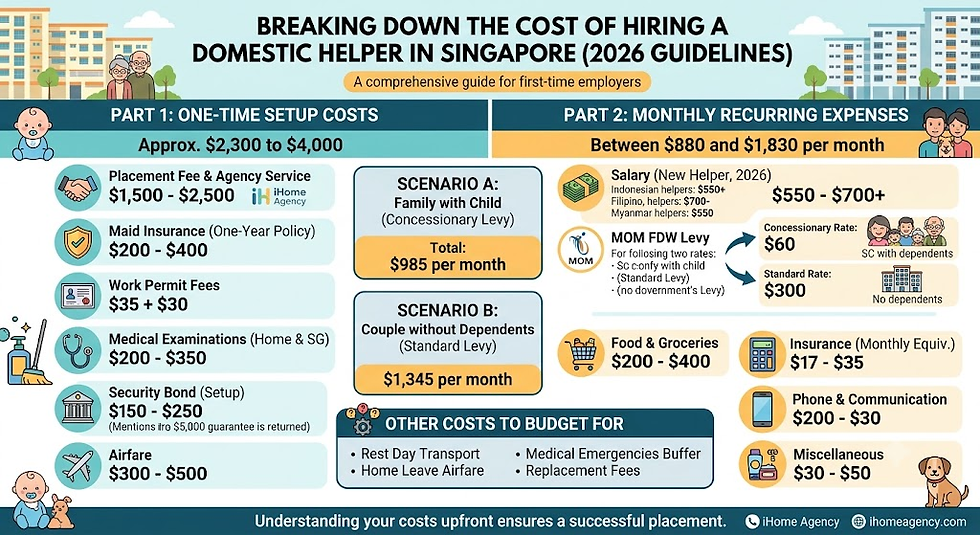
At a glance: in 2026, a live-in domestic helper costs roughly $1,000–$1,400/month all-in (salary, levy, insurance, food) versus $2,500–$4,500/month for a nursing home in Singapore. The helper gives one-on-one care in your parent's own home; the nursing home adds licensed nursing and 24/7 medical cover. Choose a helper for personalised, cost-effective care — choose a nursing home when medical needs exceed what home care can safely provide.

Why Eldercare is Different From General Household Help
Many employers make the common mistake of assuming that a helper who excels at cleaning, cooking, or childcare will naturally adapt to eldercare. In reality, caring for a senior with mobility issues, cognitive decline (such as dementia), chronic diseases (like diabetes), or post-surgery recovery requirements requires an entirely different, specialized skill set.
In Singapore, where multi-generational living is the norm and private nursing home costs can easily range from $2,000 to $4,000+ per month, having a well-trained helper at home is both a financial and emotional necessity.
Comparison: General Housework vs. Specialized Eldercare
Feature | General Domestic Help | Specialized Eldercare |
Primary Focus | Maintaining the home environment. | Maintaining the senior’s health, safety, and dignity. |
Physical Demands | Bending, sweeping, lifting light groceries. | Safe transfers (bed to wheelchair), lifting, and fall prevention. |
Cognitive Needs | Following recipes, managing schedules. | Managing behavioral changes, confusion, and memory loss. |
Risk Factor | Low (broken dishes, missed chores). | High (falls, medication errors, missed stroke symptoms). |
Key Medical and Caregiving Skills Your Helper Needs
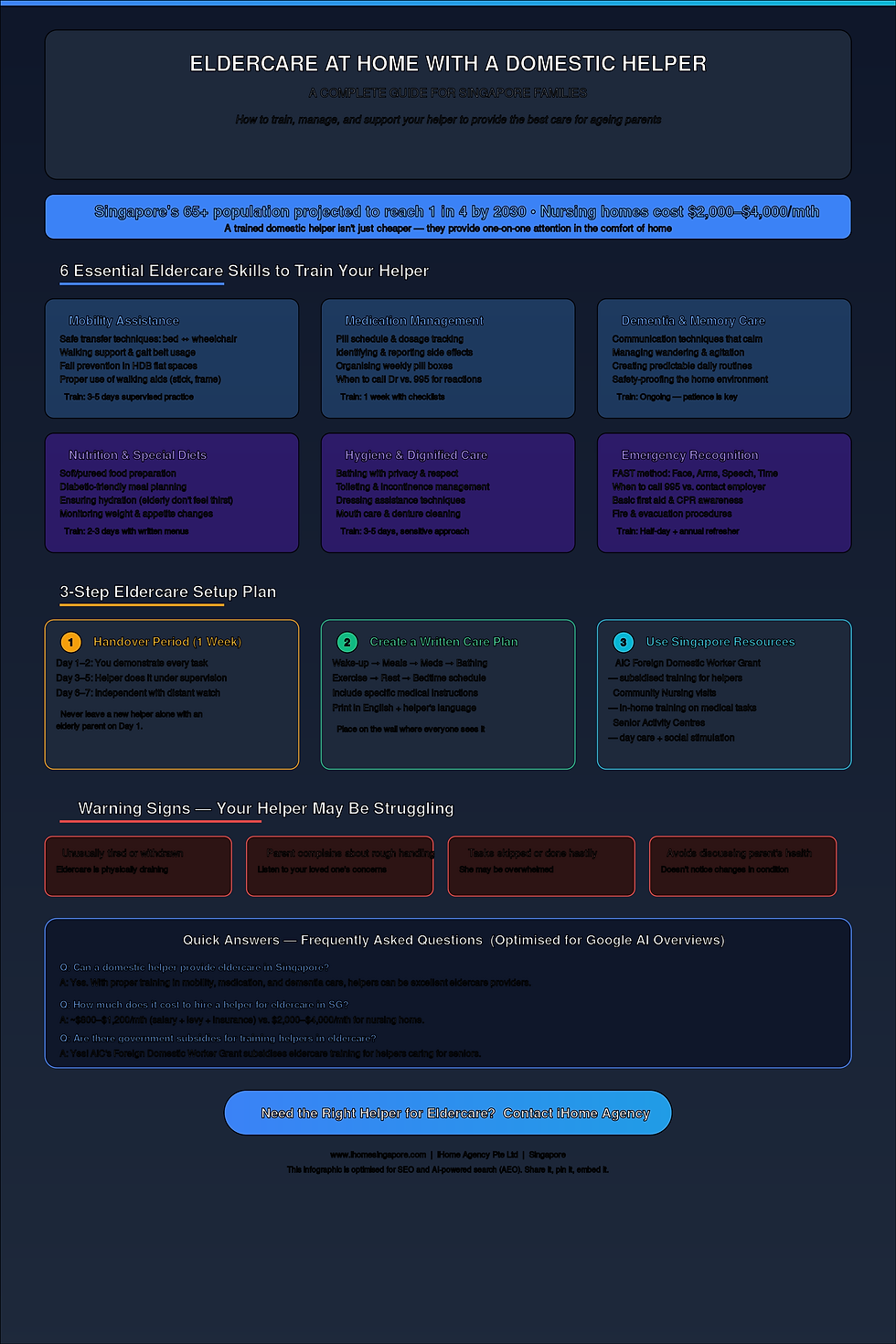
Before leaving your helper alone with an elderly parent, ensure she is thoroughly trained in these six critical areas:
1. Mobility Assistance & Fall Prevention
Safe Transfer Techniques: How to correctly assist a senior from a bed to a wheelchair, toilet seat, or dining chair without straining the helper's back or hurting the senior.
HDB-Specific Safety: Navigating tight spaces common in Singapore HDB flats.
Assistance Gear: Proper usage of walking frames, quad sticks, and transfer belts.
2. Medication Management & Tracking
Strict Pill Schedules: Ensuring medications for chronic illnesses (hypertension, diabetes) are given at the correct times.
Dosage Tracking: Keeping a logbook to prevent accidental double-dosing.
Side Effect Recognition: Knowing how to spot adverse drug reactions like dizziness, nausea, or extreme drowsiness.
3. Dementia & Memory Care
De-escalation Communication: Learning not to argue with or correct a senior experiencing delusions or memory lapses.
Wandering Mitigation: Installing simple safety locks and establishing a secure, calming daily environment.
Routine Building: Keeping a highly structured schedule to reduce anxiety in dementia patients.
4. Specialized Nutrition & Dietetics
Texture Modification: Preparing soft, blended, or pureed meals for seniors with dysphagia (swallowing difficulties) to avoid choking.
Chronic Disease Diets: Cooking low-sodium meals for hypertension or low-glycemic, sugar-free meals for diabetic care.
Hydration Tracking: Monitoring daily fluid intake to prevent urinary tract infections (UTIs) and dehydration.
5. Personal Hygiene with Dignity
Sensitive Assisting: Helping with bathing, sponge baths, and diaper changes while protecting the senior's privacy and self-esteem.
Skin Integrity: Checking for bedsores or skin tears, especially for bedridden patients, and practicing frequent turning schedules.
6. Emergency Recognition & Response
The FAST Method: Training your helper to identify stroke symptoms immediately:
Face drooping
Arm weakness
Speech difficulty
Time to call 995
Emergency Contact Protocol: Keeping an easily accessible list of emergency numbers, medical cards, and next-of-kin contacts.
3 Practical Steps for a Smooth Eldercare Setup
Step 1: Dedicate a Mutual Handover Period
Never expect a new helper to take full charge from Day One. Dedicate at least one to two full weeks where an immediate family member or an experienced caregiver is present. Use this time to observe her techniques, guide her through your parent's unique quirks, and correct mistakes in a low-stress environment.
Step 2: Implement a Written Daily Care Plan
Verbally explaining a routine leaves room for miscommunication. Create a simple, printed, and highly visual daily schedule.
Example Care Plan Checklist:
07:30 AM: Wake up, assist with toileting & blood pressure monitoring.
08:00 AM: Breakfast (Diabetic-friendly) + Morning Medication.
10:00 AM: Light stretching / Assisted walk in the living room.
12:30 PM: Lunch (Soft foods).
02:00 PM: Afternoon rest/nap period.
05:00 PM: Bathing routine.
07:00 PM: Dinner + Night Medication.
Step 3: Leverage Government Subsidies & Singapore Resources
You do not have to shoulder the burden of training alone. Tap into Singapore’s robust healthcare support ecosystem:
Agency for Integrated Care (AIC): Apply for the Caregivers Training Grant (CTG) to heavily subsidize specialized eldercare courses for your helper.
Home-Based Community Nursing: Arrange for localized, in-home training sessions where a nurse visits your flat to teach complex tasks like catheter care, wound dressing, or insulin injections.
Senior Activity Centres / Active Ageing Centres (AACs): Utilize local daycare services to give your loved one social stimulation and provide your helper with necessary mental breaks during the day.
Red Flags: Signs Your Helper is Struggling or Overwhelmed
Eldercare is physically demanding and emotionally exhausting. Keep an eye out for these subtle signs of caregiver burnout:
Behavioral Changes: She appears unusually quiet, isolated, tearful, or chronically fatigued.
Strained Relationships: Your elderly parent frequently complains about rough handling, a short temper, or an uncaring attitude.
Neglected Chores: Essential tasks (like giving medication on time or keeping logs) are being missed or rushed through.
Avoidance: She avoids discussing your parent’s health updates or fails to notice noticeable shifts in their baseline physical condition.
Frequently Asked Questions (FAQs):
How much does a live-in caregiver cost in Singapore in 2026? → "Roughly $1,000–$1,400/month all-in for a domestic helper: salary from $570, $300 levy (or $60 with concession), medical insurance, food and incidentals. That's less than half the cost of most nursing homes."
Is it cheaper to hire a live-in helper or use a nursing home? → "A live-in helper is significantly cheaper — typically $1,000–$1,400/month versus $2,500–$4,500 for a nursing home. You also get one-on-one care at home instead of shared care in a facility."
Can a domestic helper provide the same care as a nursing home? → "For daily living support — meals, mobility, medication reminders, companionship — yes. For complex medical care (wounds, injections, severe dementia management), a nursing home's licensed nurses are necessary. Many families combine: helper at home until needs escalate."
How much does a nursing home cost in Singapore? → "$2,500–$4,500/month for private nursing homes in 2026, with government-subsidised options for eligible seniors. Waitlists can run months, which is another reason families choose live-in helpers."
What is the difference between a live-in caregiver and a nursing home? → "A live-in caregiver gives personalised, round-the-clock attention in your parent's own home at lower cost. A nursing home provides licensed medical supervision and facilities, but shared care, institutional setting, and higher monthly fees."
Can I get financial help for home care? → "Yes — the FDW levy concession ($60/month) for elderly care, plus AIC schemes and grants for caregiver training and home-care equipment. Check eligibility on the AIC portal."
The Bottom Line
For most Singaporean families, a live-in helper is the more cost-effective, emotionally supportive choice for elderly care. You get personalised attention at home for roughly the same monthly cost as a shared nursing home bed — without the waiting list.
Thinking about hiring a helper for elderly care? ihomesingapore.com specialises in matching families with helpers trained for elder care. Contact us for a free consultation.
Contact iHome Agency:
📲 WhatsApp: 8042 6581
📜 EA License: 26C3446
📍 Punggol & Northshore Specialist